Why Your Backflow Assembly Gets Tested Every Year
A backflow assembly looks like a few feet of brass pipe, but it is the only thing standing between your plumbing and the public water supply.
October 7, 2026 · 4 min read
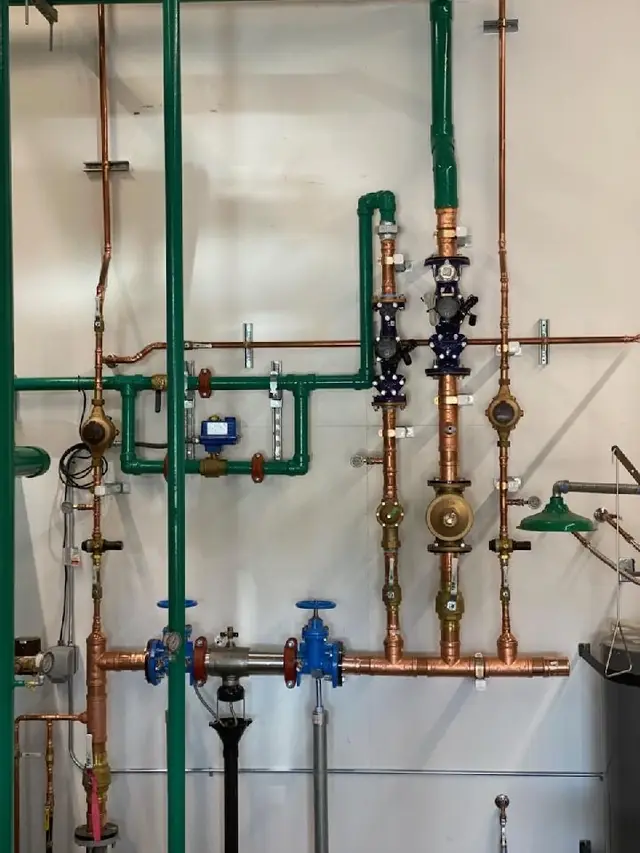
If you have a sprinkler system, a fire line, a boiler feed, or a commercial building on a city water main, there is a good chance you have a backflow assembly near the meter or in the mechanical room. It looks like a short run of brass or bronze pipe with a couple of shutoff valves and small test cocks on the side. Most people forget it exists until a notice shows up saying the yearly test is due. This post explains what that assembly does and why the test comes around every year.
What a backflow assembly actually does
Water is supposed to move one way: from the city main, through your meter, into your building. Backflow is when it moves the other way. A main break down the street, a hydrant being opened, or a pump on your own system can drop the pressure in the city line below the pressure in your pipes. When that happens, whatever sits on your side of the assembly can get pulled back toward the public supply. That might be sprinkler water that has been standing in the lines since spring, fertilizer or chemicals from an irrigation injector, boiler water, or the contents of a bucket with a hose left in it.
The assembly is a one-way door built out of check valves, and in some designs a relief valve between them. Its whole job is to keep your side of the pipe from ever feeding back into the public side. When it works, nobody notices. When it does not, the water that comes back is not safe to drink.
Why the test happens every year
City codes require backflow testing to be completed yearly. That is the plain answer, and it covers homes with irrigation systems as well as apartment complexes, offices and commercial buildings. The reason behind the rule is simple. Check valves are mechanical parts. They have springs, rubber seats and moving discs, and they sit in water that carries grit, mineral scale and the occasional bit of debris from the main.
Backflow preventers can also get damaged unexpectedly. A hard freeze that was not drained out of the assembly can crack a body. A water hammer event can beat up a check seat. A chip of scale can wedge under a disc and hold it open a hair. None of that announces itself. The water still runs, the sprinklers still pop up, and the building looks fine from the outside. The only way to know the assembly still holds is to put gauges on it and test it.
Water that has been exposed to backflow is unsafe to drink. That single fact is why cities treat this as a safety item and not a paperwork item.
What happens during the test
A certified tester connects a differential pressure gauge to the test cocks on the assembly, then works through a set sequence. The tester closes the shutoff valves in order, bleeds pressure through the test cocks, and watches the gauge to see whether each check valve holds against reverse pressure. On assemblies with a relief valve, the tester also watches the pressure at which that valve opens, since it has to open at the right point to do its job.
The visit is usually short. The tester needs access to the assembly, which means clearing snow, brush or stored boxes away from it, and for indoor assemblies, getting into the mechanical room. Water to the building or the irrigation zone is shut off briefly during the test, so it helps to tell the people inside before the tester arrives. When the assembly passes, the tester records the readings on a test report.
What happens when an assembly fails
A failed test is not a disaster. It is the test doing its job. Most failures come down to a fouled check seat or a worn spring, and the fix is often a rebuild kit: new rubber, new discs, new springs, then a retest. If the body is cracked or the assembly is simply worn out, replacing it is the better answer. Either way, you want to learn about it from a gauge and a plumber, not from a neighbor asking why the water tastes strange.
Keep the paperwork from every test. If the city asks for proof, a dated test report from a certified tester is what they want, and having last year's copy handy makes it easy to see when the next one comes due.
Getting ready for the tester
- Clear a path to the assembly, indoors or outdoors, and move anything stored in front of it.
- Find last year's test report so the tester can compare readings.
- Tell tenants, staff or family that water will be off briefly during the test.
- Note any change since last year, such as a new irrigation zone, a repair on the line, or a pressure swing you noticed.
- If the assembly sits outside in an enclosure, make sure the cover opens and is not frozen shut.
Scheduling yours
Apex Plumbing & Mechanical Piping has a certified backflow assembly tester who works on homes, apartment complexes, offices and commercial buildings around the Yakima Valley. If your test is due, or you are not sure where your assembly even is, call (509) 575-0148 or request a free quote and we will sort it out with you.
Apex Plumbing & Mechanical Piping, (509) 575-0148
Call (509) 575-0148More articles
What Gets Decided Before Concrete Covers Radiant Loops
A radiant slab is the one mechanical system you cannot get back to, so the real work happens while the floor is still open.
How to Find a Sewer Gas Smell in Your Home or Shop
A drain odor is a symptom, and the plumber's job is to turn it into an address.