How Snowmelt Works for a Driveway, Walkway or Deck
Warming the surface is the easy part of a snowmelt system; deciding where the water goes is the real design work.
October 7, 2026 · 4 min read
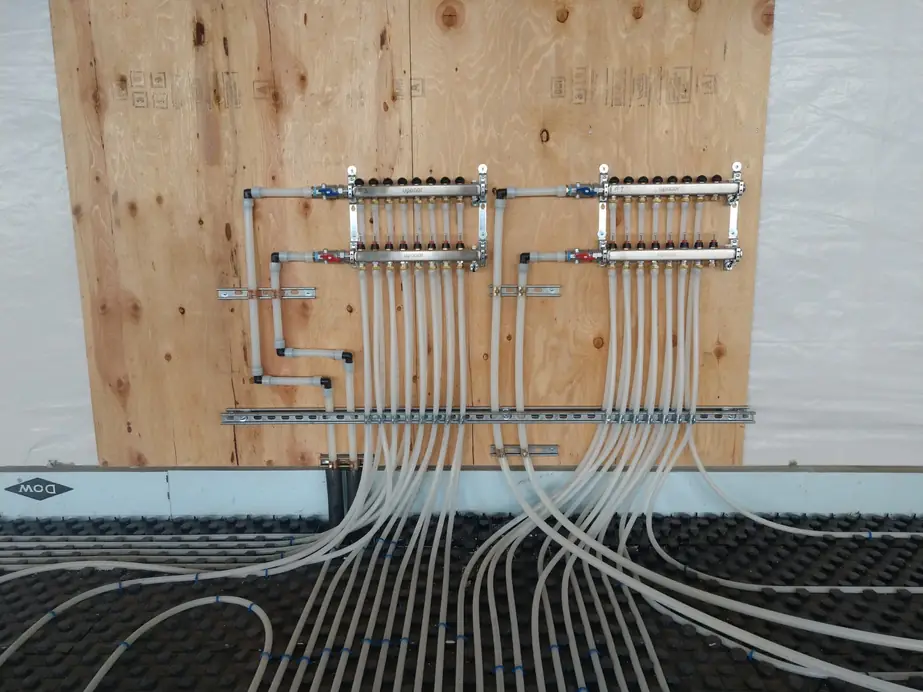
Anyone who has shoveled a long driveway at six in the morning has thought about a snowmelt system. In Central Washington, with cold snaps, freeze and thaw cycles and ice that forms overnight, it is a reasonable thing to want. The idea is simple: warm the surface from underneath so snow melts as it lands. What matters is how the system is built, because a good one and a poor one look identical until the first storm.
The basic parts
A hydronic snowmelt system has four parts. Tubing is laid under the surface, usually PEX, in loops spaced evenly across the area. A heat source, typically a boiler or a heat exchanger tied to one, warms the fluid. Pumps and a manifold move that fluid through the loops. And controls decide when the system runs. The fluid is normally a mix of water and antifreeze, because a pipe full of plain water in a driveway would freeze and split the first cold night the system was off.
Tubing in the slab, pavers or deck
For a concrete driveway or walkway, the tubing is tied to the reinforcing wire or rebar before the pour and sits in the upper part of the slab, where the heat does not have far to travel. Under pavers, the tubing goes into the sand or stone bed. A deck or stoop can be done too, with the tubing set into a topping slab or under the deck surface, depending on how it is built. It is far easier to put snowmelt in while the surface is already being built, because a retrofit means tearing out what is there.
The heat source and controls
Snowmelt needs a lot of heat for its size, because it has to melt a heavy snowfall quickly and not just hold a room at a comfortable temperature. The boiler has to be sized for the surface area and for the worst storm you want it to handle. That is a design decision and not a guess, and it is one reason to give snowmelt its own boiler or its own heat exchanger instead of piling it onto the house heating system. An undersized system will keep up with light snow and fall behind in the storm you bought it for.
A snowmelt system that runs all winter wastes fuel, and one that runs only when you remember to switch it on is not much better. Most systems use a sensor that detects cold and moisture at the surface and starts the system when both are present. Some also idle the slab at a low temperature so it responds faster. Others add a manual override for when you know a storm is on the way. Good controls are the difference between a driveway that is clear at dawn and one that is half melted and refrozen.
Drainage is half the design
Melting the snow is only half the job. Now you have water, and in a Central Washington winter that water will refreeze the minute it leaves the heated area. A snowmelt driveway that sheds water onto an unheated sidewalk, a street or a garage door apron creates a sheet of ice just past the edge. So the design has to account for where the melt goes.
Apex can create a system that melts the snow and directs the moisture away from your property. In practice that means sloping the heated surface so water moves in a known direction, giving it somewhere to go such as a drain, a gravel bed or a graded area that carries it off, and keeping the drainage path from stopping at a cold edge. Think about the edges, the bottom of a slope, and any place where a heated surface meets an unheated one. Those are the spots where ice shows up first.
What to settle before you build
- How much area you actually need heated. Tire tracks and a walking path use less heat than a full-width apron.
- Where the heat will come from and whether that source has room for the load.
- Where the melt water leaves the surface and where it ends up.
- Where the manifold and pumps will live, with access for service.
- What the surface will be, concrete, pavers or deck, and who is building it, so the tubing is in before the finish goes on.
- How the controls start the system, and whether you want a manual override.
Talk to a plumber early
Apex installs snowmelt systems for decks, driveways and other areas with snow accumulation, along with the hydronic heating and radiant floor work that often goes with it. Call (509) 575-0148 or request a free quote, and bring a sketch or a photo of the area.
Apex Plumbing & Mechanical Piping, (509) 575-0148
Call (509) 575-0148More articles
Why Your Backflow Assembly Gets Tested Every Year
A backflow assembly looks like a few feet of brass pipe, but it is the only thing standing between your plumbing and the public water supply.
What Gets Decided Before Concrete Covers Radiant Loops
A radiant slab is the one mechanical system you cannot get back to, so the real work happens while the floor is still open.